
Dental Bridge vs Implant: Which Fits Best?
Missing a tooth can change more than your smile. It can affect how you chew, how clearly you speak, and how confident you feel when you laugh or talk. If you are weighing a dental bridge vs implant, the right choice often comes down to your oral health, timeline, budget, and long-term goals.
Both options can restore function and appearance very well. Both can be customized to blend naturally with your smile. But they work in different ways, and that matters when you are deciding what will feel right now and what will serve you well for years to come.
Dental bridge vs implant: the basic difference
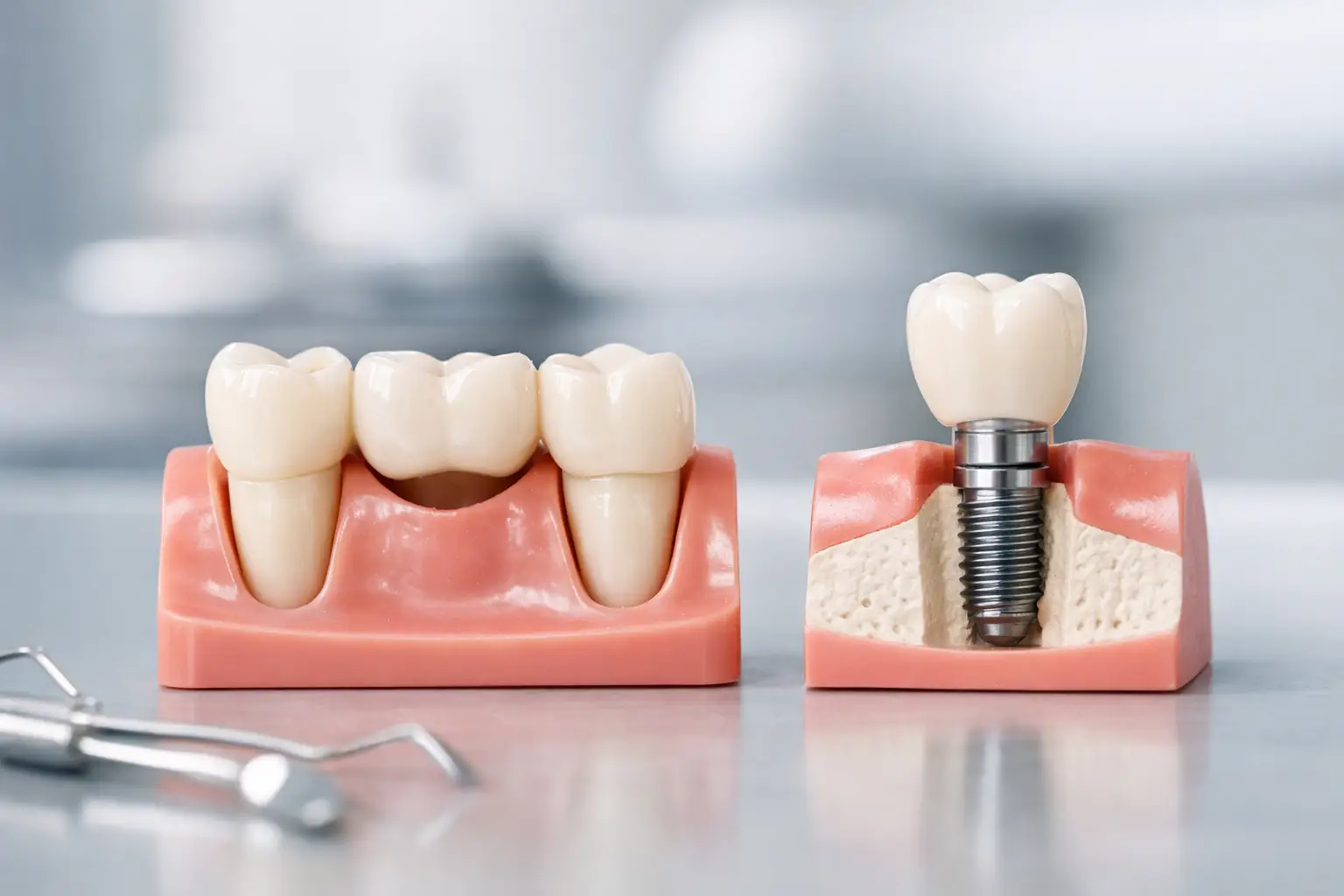
A dental bridge replaces a missing tooth by anchoring an artificial tooth to the teeth on either side of the gap. Those neighboring teeth are usually prepared to support crowns, and the false tooth sits between them to “bridge” the space.
A dental implant replaces the tooth root as well as the visible tooth. A small titanium post is placed into the jawbone, and after healing, a custom crown is attached on top. That makes an implant a more independent replacement, since it does not rely on the teeth next to it for support.
This one difference shapes almost everything else – treatment time, cost, maintenance, and the effect on surrounding bone and teeth.
When a dental bridge may make more sense
A bridge is often appealing because it can be completed faster than an implant. If you want to restore your smile and chewing ability without waiting several months for healing, a bridge may feel like the more practical path.
It can also be a good option when the teeth beside the missing tooth already need crowns. In that case, using those teeth as supports may fit naturally into a treatment plan that is already restorative.
Some patients are also better candidates for a bridge because they prefer to avoid surgery, or because they do not have enough bone for an implant and do not want a bone graft. For someone looking for a predictable, time-efficient solution, a bridge can be an excellent choice.
That said, a bridge does ask more of the neighboring teeth. Healthy teeth usually need to be reshaped to hold the crowns, and that is an important trade-off to understand before moving forward.
When an implant may be the better choice
An implant is often the closest replacement to a natural tooth because it stands on its own. It helps stimulate the jawbone, which can reduce bone loss in the area over time. That bone support is one reason implants are often considered the longer-term option.
An implant may be especially attractive if the adjacent teeth are healthy and do not need crowns. Instead of altering those teeth, the implant restores the missing space without involving them.
Many patients also like the feel of an implant. Because it is anchored in the bone, it tends to feel stable and secure when chewing. For a single missing tooth, that independence can be a major advantage.
Still, implants are not always the immediate answer. They require healing time, good oral health, and enough bone support. They also involve a higher upfront investment in many cases.
Cost, timing, and long-term value
For many families, the biggest practical question in dental bridge vs implant decisions is cost. A bridge often has a lower initial price than an implant, which can make it easier to move forward with treatment sooner.
An implant usually costs more upfront because it involves placement surgery, healing, and the final restoration. If bone grafting is needed, that can add to the total treatment cost and timeline.
But upfront cost is only one part of value. Bridges can wear out or need replacement over time, especially if the supporting teeth develop decay or gum issues. Implants, when well cared for, can last a very long time. The crown on top may eventually need replacement, but the implant itself can often remain stable for many years.
So the real question is not simply which option is cheaper. It is whether you need the faster, more accessible solution now or whether you are planning around the longest-term outcome possible.
How each option affects nearby teeth and bone
This is where the decision becomes more personal and more clinical.
A bridge depends on neighboring teeth for support. If those teeth are strong but already restored, that may be completely reasonable. If they are healthy and untouched, preparing them for crowns may feel like a bigger compromise.
An implant does not rely on surrounding teeth, which helps preserve their natural structure. It also helps maintain stimulation in the jawbone. After a tooth is lost, the bone in that area can begin to shrink because it is no longer supporting a root. An implant can help slow that process.
A bridge does not provide that same bone stimulation. It restores the visible gap well, but underneath the gums, bone changes can still occur over time.
Neither option is automatically better for every person. It depends on the condition of your teeth, gums, and bone, along with your priorities.
Comfort, healing, and daily life
Some patients assume a bridge must be easier because it does not involve implant surgery. In the short term, that can be true. A bridge is generally quicker to complete, and recovery is usually simpler.
Implants involve a healing phase after placement. That can sound intimidating, especially if you already feel anxious about dental treatment. The good news is that many patients find the procedure more manageable than they expected, particularly when it is carefully planned and explained.
In everyday use, both bridges and implants can look very natural and allow you to eat and speak more comfortably than you would with a missing tooth. Over time, however, some patients feel that an implant behaves more like a natural tooth because it is fixed directly in the jaw.
Comfort also depends on maintenance. A bridge may require extra attention when cleaning under the artificial tooth, while an implant must be kept clean around the gums to protect the surrounding tissue.
Maintenance and oral hygiene
A bridge and an implant both need good home care and regular dental visits. Neither is a set-it-and-forget-it treatment.
With a bridge, cleaning under the pontic, or replacement tooth, is important because food and plaque can collect around it. Special flossing tools or interdental cleaners may be recommended. If plaque builds up around the supporting teeth, the entire bridge can be at risk.
With an implant, the focus is keeping the gum tissue healthy around the implant. Implants cannot get cavities, but the surrounding gums and bone can still develop inflammation if plaque is not controlled.
For patients who want the simplest brushing and flossing routine, the answer is not always obvious. An implant may feel more like caring for a natural tooth, but only if the gums remain healthy. A bridge can work beautifully too, as long as you are comfortable with the added cleaning technique.
Who may not be an ideal candidate for an implant?
Implants are an excellent option, but not everyone is ready for one right away. Active gum disease, significant bone loss, uncontrolled health conditions, or smoking can all affect healing and long-term success.
That does not always mean an implant is off the table. In some cases, gum treatment, bone grafting, or health improvements can make implant treatment possible later on. But if you want to replace a tooth sooner, a bridge may be the more practical option.
This is one reason a personalized exam matters so much. The best treatment is not just about the missing tooth. It is about the whole mouth and the overall health picture.
Dental bridge vs implant: what matters most for your decision
If you want the shortest path to restoring a visible gap, a bridge may stand out. If you want to preserve nearby teeth and support the jawbone, an implant may deserve a closer look.
If your neighboring teeth already need crowns, a bridge can be a very logical choice. If those teeth are healthy and you want to keep them untouched, an implant may offer a stronger long-term fit.
And if budget is your biggest concern, it is worth discussing both the initial cost and the likely maintenance or replacement needs over time. Sometimes the best choice is the one that fits your life now. Sometimes it is the one that prevents bigger compromises later.
At a patient-focused practice like Nevis Dental, that conversation should feel clear and comfortable, not rushed. You deserve a treatment plan that reflects your health, your priorities, and how you want your smile to feel day to day.
The next right step is not picking a winner between bridges and implants on your own. It is getting an honest evaluation, asking the questions that matter to you, and choosing the option that helps you eat, smile, and speak with confidence again.
